%20--%3e%3csvg%20version='1.1'%20id='Layer_1'%20xmlns='http://www.w3.org/2000/svg'%20xmlns:xlink='http://www.w3.org/1999/xlink'%20x='0px'%20y='0px'%20viewBox='0%200%20120.17%2045.43'%20style='enable-background:new%200%200%20120.17%2045.43;'%20xml:space='preserve'%3e%3cg%3e%3cpath%20d='M32.33,0v16.13c0,2.21-0.42,4.3-1.26,6.26c-0.84,1.97-2,3.7-3.49,5.18c-1.49,1.49-3.2,2.65-5.15,3.49%20c-1.94,0.84-4.04,1.26-6.3,1.26c-2.21,0-4.3-0.42-6.26-1.26c-1.97-0.84-3.68-2-5.15-3.49c-1.46-1.49-2.62-3.21-3.46-5.18%20C0.42,20.42,0,18.34,0,16.13V0h6.41v16.13c0,1.34,0.25,2.62,0.76,3.82c0.5,1.2,1.2,2.24,2.09,3.13c0.89,0.89,1.92,1.58,3.1,2.09%20c1.18,0.5,2.44,0.76,3.78,0.76c1.34,0,2.62-0.25,3.82-0.76c1.2-0.5,2.24-1.2,3.13-2.09c0.89-0.89,1.58-1.93,2.09-3.13%20c0.5-1.2,0.76-2.47,0.76-3.82V0H32.33z'%20fill='%232563eb'%20/%3e%3cpath%20d='M50.4,0.14c2.26,0,4.36,0.42,6.3,1.26c1.94,0.84,3.66,1.99,5.15,3.46c1.49,1.46,2.65,3.17,3.49,5.11%20c0.84,1.94,1.26,4.04,1.26,6.3c0,2.21-0.42,4.3-1.26,6.26c-0.84,1.97-2,3.7-3.49,5.18c-1.49,1.49-3.2,2.65-5.15,3.49%20c-1.94,0.84-4.04,1.26-6.3,1.26h-9.72v12.96h-6.41V16.27c0-2.26,0.42-4.36,1.26-6.3c0.84-1.94,1.99-3.65,3.46-5.11%20c1.46-1.46,3.18-2.62,5.15-3.46C46.1,0.56,48.19,0.14,50.4,0.14z%20M54.22,25.31c1.2-0.5,2.24-1.2,3.13-2.09%20c0.89-0.89,1.58-1.93,2.09-3.13c0.5-1.2,0.76-2.47,0.76-3.82c0-1.34-0.25-2.6-0.76-3.78c-0.5-1.18-1.2-2.21-2.09-3.1%20c-0.89-0.89-1.93-1.58-3.13-2.09c-1.2-0.5-2.47-0.76-3.82-0.76c-1.34,0-2.6,0.25-3.78,0.76c-1.18,0.5-2.21,1.2-3.1,2.09%20c-0.89,0.89-1.58,1.92-2.09,3.1c-0.5,1.18-0.76,2.44-0.76,3.78v9.79h9.72C51.74,26.06,53.02,25.81,54.22,25.31z'%20fill='%232563eb'/%3e%3cpath%20d='M94.03,20.95l4.54,4.54l-2.23,2.23c-1.54,1.54-3.29,2.71-5.26,3.53c-1.97,0.82-4.03,1.22-6.19,1.22%20c-2.16,0-4.22-0.41-6.19-1.22c-1.97-0.82-3.72-1.99-5.26-3.53c-1.58-1.58-2.76-3.37-3.53-5.36c-0.77-1.99-1.15-4.02-1.15-6.08%20c0-2.06,0.38-4.08,1.15-6.05c0.77-1.97,1.94-3.74,3.53-5.33s3.37-2.77,5.36-3.56c1.99-0.79,4.02-1.19,6.08-1.19%20c2.06,0,4.09,0.4,6.08,1.19c1.99,0.79,3.78,1.98,5.36,3.56l2.23,2.23L80.64,25.06c1.82,0.91,3.75,1.21,5.8,0.9%20c2.04-0.31,3.83-1.24,5.36-2.77L94.03,20.95z%20M77.98,9.36c-1.92,1.92-2.88,4.22-2.88,6.91c0,1.49,0.33,2.9,1.01,4.25%20c0.58-0.58,1.45-1.45,2.63-2.63c1.18-1.18,2.42-2.42,3.74-3.74c1.32-1.32,2.59-2.58,3.82-3.78c1.22-1.2,2.17-2.14,2.84-2.81%20c-1.83-0.91-3.76-1.22-5.8-0.94C81.3,6.91,79.51,7.82,77.98,9.36z'%20fill='%232563eb'%20/%3e%3cpath%20d='M120.17,0v6.41h-3.24c-1.35,0-2.61,0.25-3.78,0.76c-1.18,0.5-2.21,1.2-3.1,2.09c-0.89,0.89-1.58,1.92-2.09,3.1%20c-0.5,1.18-0.76,2.44-0.76,3.78v16.2h-6.48v-16.2c0-2.26,0.42-4.36,1.26-6.3c0.84-1.94,2-3.65,3.49-5.11%20c1.49-1.46,3.21-2.62,5.18-3.46c1.97-0.84,4.06-1.26,6.27-1.26H120.17z'%20fill='%232563eb'/%3e%3c/g%3e%3c/svg%3e)
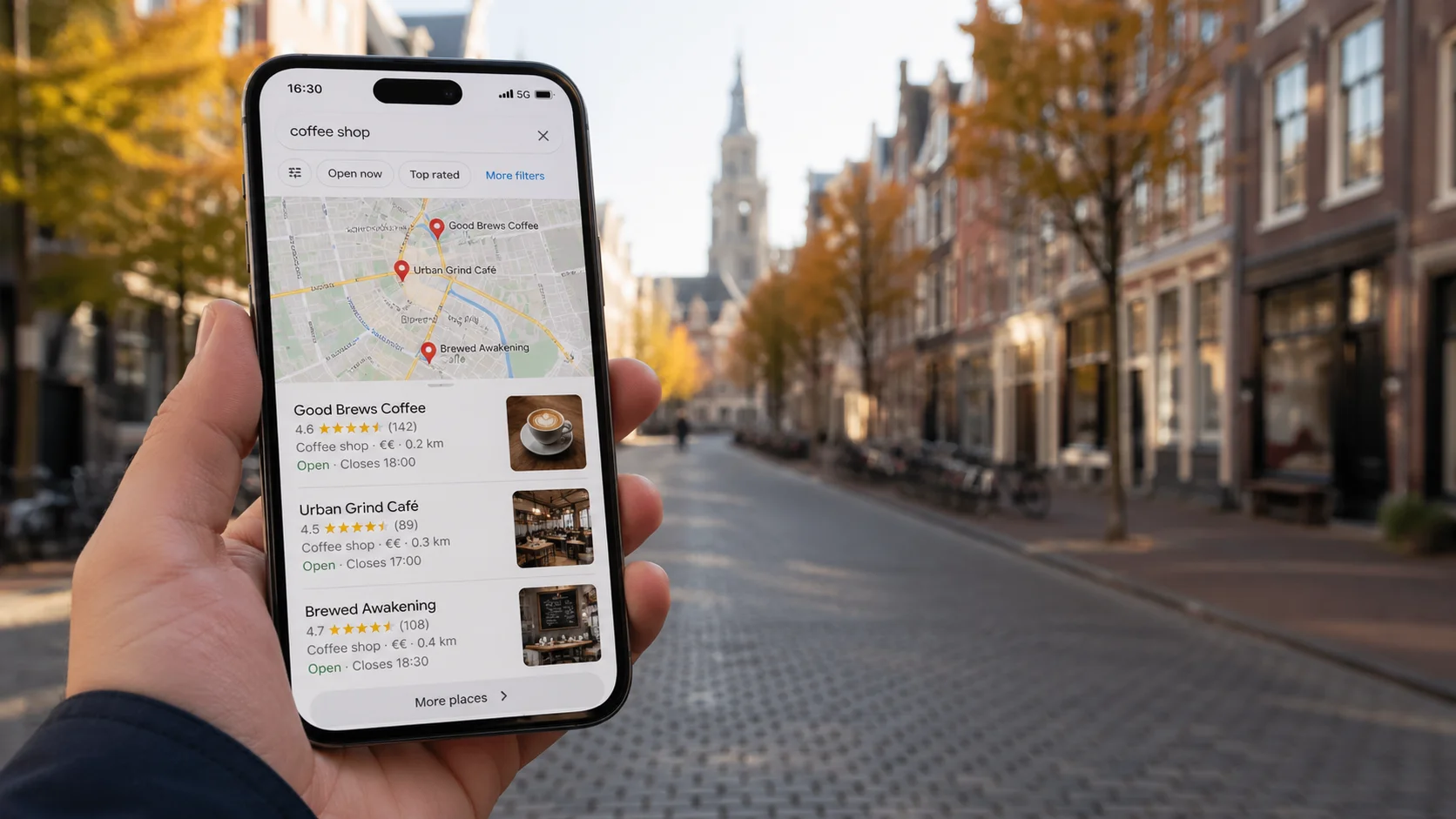
Local SEO is the discipline of getting a business surfaced for queries that carry geographic intent — “plumber near me,” “best pho in Austin,” “dentist open Sunday.” In 2026 that battle no longer happens on a list of ten blue links. It happens in three places, in this order: the AI Overview at the top of the page, the Local Pack of three Google Business Profiles with a map, and only then the classic organic listing.
If you’re not in the AI Overview and not in the top three of the Local Pack, you exist for roughly the last 10–20% of users who scroll past everything above. This guide is the 2026 playbook for getting into both — Google Business Profile, on-page signals, NAP consistency, AEO/GEO for local, and the measurement loop that tells you whether any of it is working.
Why local search changed in 2026
Three shifts make 2026 different from any previous year of local SEO:
- AI Overviews now answer most local “research” queries. Google’s AI summary at the top of the page handles “best X in Y,” “how do I find a Z near me,” and comparison queries. It cites Google Business Profiles, reviews, and authoritative websites as sources. Profiles that get cited inside the AI Overview beat profiles ranked #1 in the Local Pack, because most users stop reading after the summary.
- AI Mode and “Ask Maps” turn the Local Pack into a conversation. Inside Google Maps and the new AI Mode tab, Gemini reads your profile, services, reviews, and Q&A and generates a live conversational answer instead of waiting for the owner. Your GBP content is now direct fuel for AI answers about you and your category.
- Enforcement got faster and harsher. The March 2026 Core Update specifically targeted local quality signals. Name-stuffing sweeps remove thousands of profiles in days. Fake-review patterns are detected at the network level, not the individual review level. There’s no longer a long tail between bad behavior and consequence.
The implication: a thin Google Business Profile, copy-paste landing pages with city names swapped, and zero AI visibility strategy is no longer “below average” — it’s invisible.
Local search statistics that still matter
- 46% of all Google searches have local intent (Google internal data, unchanged for years).
- 76% of people who search locally on a phone visit the business within 24 hours, and 28% of those visits convert to a purchase (Google Consumer Insights).
- Profiles with 100% information completeness rank on average 50% higher in the Local Pack than partially filled ones (Bloggingwizard — 2026 GBP statistics).
- The primary GBP category is still the #1 ranking factor in the Local Pack (2026 Local Search Ranking Factors).
- 88% of consumers trust online reviews as much as personal recommendations (BrightLocal Local Consumer Review Survey).
How local results are displayed now
For a typical local query Google now stacks results in roughly this order:
- AI Overview with cited businesses and links (collapsible, but expanded by default for ~70% of users).
- Local Pack — three GBPs with a map.
- People also ask with related local intents.
- Organic results with local context.
- AI Mode tab — a parallel conversational view, growing fast in adoption among under-35 users.
- Google Maps — full results inside the Maps app, where ranking signals differ slightly.
Optimizing for “Local SEO” in 2026 means optimizing for all six surfaces, not just the Local Pack.
Google Business Profile — the foundation of everything
Your Google Business Profile (GBP), formerly Google My Business, is the single highest-ROI asset in local SEO. For small service businesses it generates 60–70% of all organic inquiries. We have a dedicated Google Business Profile guide for 2026 covering every section in depth — this is the condensed strategic view.
How you manage GBP in 2026
Since 2024 you manage your profile directly from Google Search — search your business name in Google while logged into the owner account, then click “Edit profile” in the side panel. The standalone business.google.com dashboard was deprecated. Don’t waste time looking for it.
Set the business type correctly
The first structural decision shapes everything downstream:
- Storefront — physical address customers visit. Restaurant, salon, dental office. Address is public.
- Service Area Business (SAB) — you travel to customers. Plumber, mobile mechanic, wedding photographer. The address is hidden; you declare a service area (cities, zip codes, regions).
- Hybrid — you have an office or showroom but mostly travel. GBP supports both.
SABs always compete with businesses physically located in the user’s city, even if you can be there in 10 minutes. Declaring “whole country” as your service area dilutes ranking — narrow it to where you actually convert.
Verification — video is now the default
In 2026 most new profiles (and almost all SABs) are verified by video: a single continuous 30-second to 5-minute recording showing exterior signage, interior, business documents, and — for SABs — a branded vehicle with visible logo and license plate. Postcard and phone verification still exist for some industries but are fading out.
After verification, the next two weeks are an algorithmic scrutiny window. Add photos, reply to reviews, but do not change name, address, phone, primary category, or website URL — you risk re-verification.
The fields that actually move ranking
Most businesses fill three things and stop: name, address, phone. The features that compound below get left empty — and that’s where the easy wins still live in 2026:
- Services tab. Add every service you offer with a 100–200 character description containing keywords in natural context. Each service gets its own card and can rank for long-tail queries the main profile would never catch (Sterling Sky — Services impact study). Algorithm response time: 24–72 hours.
- Q&A. Seed it yourself with 10–15 real questions (the ones you actually get by phone). Answer in customer language, include keywords in natural context. In 2026 Q&A snippets are quoted directly by AI Overviews and “Ask Maps.”
- Attributes. Wheelchair accessible, free WiFi, online appointments, women-owned — every truthful checkbox is a filter that can put you in front of a new segment.
- Photos. 30+ photos beats 3–5 measurably. Refresh with 2–3 new photos per month. EXIF geotagging is a debunked myth — Google strips EXIF on upload, and Sterling Sky’s controlled test found no measurable ranking effect (study).
- Posts. They’re an engagement signal, not a direct ranking signal. Use them for time-boxed offers and events, not “Happy Holidays” filler. One useful post per month beats four useless ones.
- Messaging and booking links. Only enable Messaging if you actually reply within 5 minutes during business hours. A visible “Typically replies in 12 hours” tanks profile CTR — better to leave it disabled at night.
The business name trap
Putting a keyword in your business name (“Acme Plumbing Brooklyn”) has historically been one of the strongest signals — and is now one of the riskiest moves. The March 2026 Core Update accelerated enforcement: profiles flagged for stuffing get soft-suspended (you lose management access, Google strips the keyword), feature-stripped (Booking, Messaging, Posts removed but profile stays), or fully suspended off Maps. Competitors report you on day one (Tinkerlytics — keyword stuffing penalties).
Rule of thumb: your GBP name should match the signage on your verification video. If it doesn’t match, it’s spam.
Reviews — briefly
Reviews are the second strongest GBP signal after the Services tab, and they fuel both Local Pack rank and AI Overview citations. The full strategy is in the dedicated guide on Google reviews and local SEO. The short version:
- Volume matters up to about 50–100 reviews; beyond that, pace of new reviews matters more than total.
- Average 4.6–4.9 outranks a “perfect” 5.0 — Google detects unnatural distributions.
- Reply to every review, including 5-star ones. Activity signal + a legitimate excuse for natural keyword use.
- Never buy reviews. The April 2026 policy update tightened pattern detection — fake-review networks get caught at the cluster level, not the individual level (Launchcodex — review policy update).
Local landing pages
When you operate in more than one city — or you want to rank for “[service] + [city]” without having a storefront in each — local landing pages do the work the GBP can’t.
When local pages are warranted
- You serve multiple cities and neighborhoods.
- You don’t have (or don’t want) a physical location in each one.
- You want organic traffic for “[service] + [city]” intents alongside the Local Pack.
Page structure that holds up in 2026
<title>Plumber Austin — 24/7 Emergency Service | Company XYZ</title>
<meta name="description" content="Plumber in Austin? 24/7 plumbing services,
free estimates, service warranty. Call: 512-456-7890">
# Plumber Austin — 24/7 Plumbing Services
## Our plumbing services in Austin
### Emergency plumbing
### Pipe replacement
### Fixture installation
## Why customers in Austin choose us
## Service area — Austin neighborhoods we cover
## Contact — Plumber AustinContent that survives the next Core Update
Every local page must have content that couldn’t exist for any other city. The 2026 Helpful Content signal punishes city-swap templates hard.
What works:
- Travel times from named neighborhoods (and concrete examples from past jobs).
- Local landmarks, building types, road conditions specific to the region.
- Service specifics that change by location (winter heating systems in Minneapolis ≠ Miami).
- Real customer references with first names + neighborhood + project type.
- Project photos shot in that city, with descriptive alt text.
What kills the page:
- Copy-paste with only the city name swapped.
- Template paragraphs with no local detail.
- Thin content under ~400 words.
Structured data on local pages
Implementing Schema.org for local businesses increases the chance of being parsed correctly by Google and cited by AI Overviews:
{
  "@context": "https://schema.org",
  "@type": "LocalBusiness",
  "name": "Plumber Austin — Company XYZ",
  "address": {
    "@type": "PostalAddress",
    "streetAddress": "123 Example Street",
    "addressLocality": "Austin",
    "postalCode": "78701",
    "addressCountry": "US"
  },
  "telephone": "+15124567890",
  "openingHours": "Mo-Fr 08:00-18:00",
  "geo": {
    "@type": "GeoCoordinates",
    "latitude": "30.2672",
    "longitude": "-97.7431"
  }
}
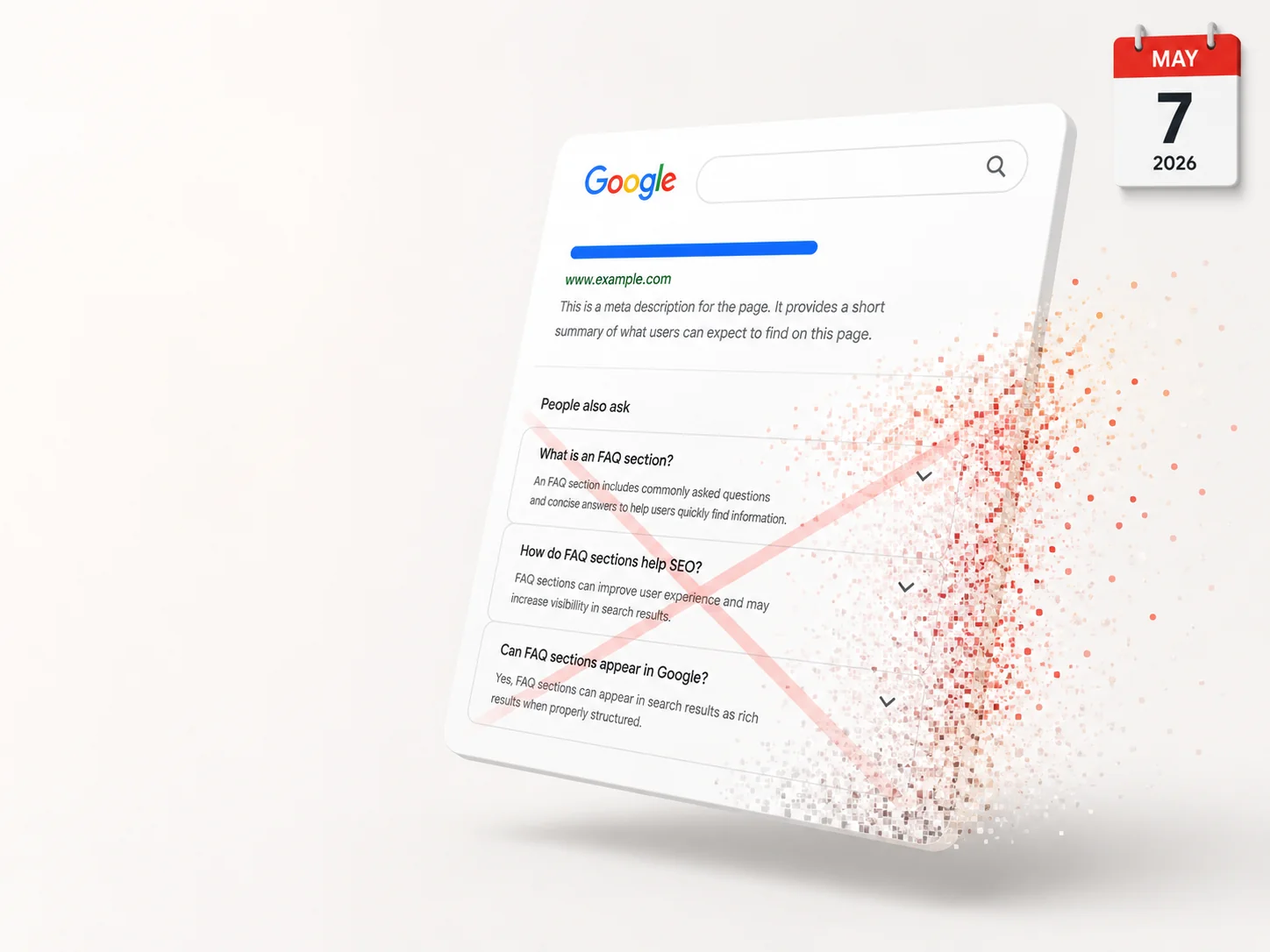
Note on FAQ rich results: Google retired FAQ rich results on May 7, 2026. The FAQ search-appearance report leaves Search Console in June 2026, and API support is removed in August 2026. FAQPage markup is still readable by AI Overviews and worth keeping — but stop relying on it to expand your SERP footprint.
Map embed and CTA
Embed Google Maps near the contact section — it helps users navigate, reinforces the local signal, and increases time on page. Pair it with a clickable phone (tel: link), a contact form, and a sticky “Call now” button on mobile.
NAP and local citations
A citation is any mention of your business online with NAP data — Name, Address, Phone. Citations appear in business directories, industry portals, social profiles, and local news. Google evaluates them in aggregate as a consistency signal.
NAP consistency is non-negotiable
The data must be byte-identical across every source:
| Source | Name | Address | Phone |
|---|---|---|---|
| Google Business Profile | Company XYZ | 123 Example St | 512-456-7890 |
| Website | Company XYZ | 123 Example St | 512-456-7890 |
| Company XYZ | 123 Example St | 512-456-7890 | |
| Yelp | Company XYZ | 123 Example St | 512-456-7890 |
Common consistency breaks:
- “St.” vs “Street” vs missing.
- Different phone numbers (tracking numbers especially — be careful).
- Old addresses lingering after a move.
- Variant business names (“Company XYZ” vs “Company XYZ LLC” vs “XYZ”).
Running a periodic NAP consistency audit catches these before they corrode your local ranking.
Where to build citations
- General directories: Google Business Profile, Yelp, Yellow Pages, Bing Places, Apple Maps.
- Industry directories: vertical-specific portals (Healthgrades for medical, Avvo for legal, TripAdvisor for hospitality).
- Local sources: chamber of commerce, BBB, regional business associations.
- Social profiles: Facebook Business, LinkedIn Company Page, Instagram Business — with NAP in the bio/About section.
AEO and GEO for local — getting cited by AI Overviews
This is the section that didn’t exist in this guide a year ago, and it’s the one that separates 2026 local SEO from 2024 local SEO. Answer Engine Optimization (AEO) and Generative Engine Optimization (GEO) are about being cited as a source by the AI Overview, not just ranking under it.
For local queries, AI Overviews cite three sources reliably:
- The Google Business Profile itself — categories, Services tab, Q&A, reviews.
- The business’s own website — when it has clear, scannable content that answers a specific local question.
- Third-party authoritative pages — review aggregators, local press, industry directories.
What gets you cited:
- Direct, scannable answers. A short paragraph that opens with the question rephrased, followed by a concrete, specific answer. AI Overview models extract these as quotable spans.
- Concrete numbers and named places. “We service 12 neighborhoods including East Austin and Mueller” reads as a citable fact. “We service the Austin area” doesn’t.
- Schema.org consistency.
LocalBusiness+Service+FAQPageon relevant pages signals what each chunk of content means. - Mentions in local press and authoritative directories. AI Overviews triangulate across sources. Being named in three places counts more than being named in one.
Full playbook on writing content that LLMs will cite is in our AI visibility guide for LLMs. The local twist: include the city/region name in every quotable paragraph — AI Overviews disambiguate by geography.
Technical optimization for local SEO
Mobile-first is non-negotiable
The overwhelming majority of local searches happen on phones. The page has to load fast, the tap targets have to be big, and the phone number has to be one tap from the top of the screen.
- Responsive design with realistic font sizes on mobile.
- Fast loading — see our guide to Core Web Vitals.
tel:links on every phone number.- A sticky bottom-of-screen call/contact bar on mobile.
HTTPS, speed, and crawlability
- SSL certificate, HTTPS-only with proper redirects, no mixed content.
- Image optimization, lazy loading, CDN, aggressive cache headers.
- Clean internal linking so Google can reach every local landing page in 1–2 clicks from the homepage.
External linking for local SEO
Local link signals still matter. Pursue them through real-world activity, not link farms:
- Local media — guest contributions, expert quotes in articles, sponsorship coverage.
- Sponsorships — youth sports teams, community events, local non-profits.
- Partnerships — co-marketing with adjacent local businesses.
- Organizations — chamber of commerce, industry guilds, regional associations.
For local guest posting, stick to genuine value and the principles of White Hat SEO. One contextual link from a local paper outweighs 20 links from a generic directory.
Monitoring local SEO results in 2026
Metrics that matter
- Local Pack position for your priority queries (tracked from a real local IP via tools like Local Falcon, BrightLocal, Whitespark — desktop tracking lies about local).
- AI Overview citations — track which of your pages and GBP fields show up as sources for branded and category queries.
- GBP Insights — discovery vs direct searches, calls, direction requests, profile views, photo views, post views.
- Reviews — volume, pace, average rating, response rate.
- Organic traffic to local landing pages in GA4, segmented by city.
- Conversions per location — calls, form submissions, bookings.
Tools
- Google Search Console — clicks, impressions, queries. Note: the FAQ search appearance report disappears in June 2026 (deprecation timeline). Don’t anchor reporting around it.
- Google Business Profile Insights — built into the profile.
- Google Analytics 4 — traffic and conversions on local landing pages.
- Local Falcon / BrightLocal / Whitespark — grid-based local rank tracking (the only reliable way to track Local Pack from multiple geo-points).
- Profile Performance API — for businesses with many locations.
Common local SEO mistakes in 2026
- Keyword stuffing in the business name. Soft suspension, feature stripping, or full removal — pick your poison (details).
- Duplicate GBPs at one address. One business = one profile. Duplicates get flagged as spam and tank both profiles.
- NAP drift across sources. Different phone, address variations, abandoned old addresses. Audit quarterly.
- Copy-paste city pages. The 2026 Helpful Content signal hits these harder than ever. If you can’t say something specific about that city, don’t make the page.
- Ignoring reviews. No response, no acquisition process, no negative-review playbook.
- No mobile optimization. Slow, unreadable, no clickable phone.
- Treating posts as a ranking lever. They’re an engagement signal, not a direct ranking signal. Don’t grind out weekly “Happy Friday” posts.
- Building a service-area SAB that covers an entire country. Dilutes ranking everywhere. Narrow to where you actually convert.
- No AEO/GEO strategy. Ranking #1 in the Local Pack with no AI Overview citation still loses traffic to whoever is cited above the pack.
- Set-and-forget. A profile with 30+ days of zero activity (no photos, no posts, no review replies) starts losing visibility regardless of how well-set-up it is.
Summary
Local SEO in 2026 is a stack, not a single lever:
- Google Business Profile — fill every field, use Services and Q&A, manage from Google Search directly. Deep-dive: GBP 2026 guide.
- Local landing pages — one unique page per city you serve, with real local detail, not city-swap templates.
- Structured data —
LocalBusiness+ Service schema, NAP-consistent. See Schema.org for Local SEO. FAQPage still useful for AI Overview citations, but no longer for SERP rich results. - NAP citations — byte-identical across every source. See NAP consistency audit.
- Reviews — acquisition process, response to every review, no fake-review games. See Google reviews and local SEO.
- AEO / GEO — write to be cited by AI Overviews and AI Mode. See AI visibility for LLMs.
- Technical baseline — mobile-first, fast, HTTPS, crawlable.
- Local links and PR — earned through real-world activity, not directories.
- Measurement — Local Pack rank from real geo-points, AI Overview citations, GBP Insights, GA4 by city.
Effective local SEO takes 3–6 months of consistent execution to compound. The shortcut still doesn’t exist — but the discipline is more rewarded than ever now that competitors are getting feature-stripped for trying to cheat.
Często zadawane pytania
Is Google Business Profile still the most important local SEO signal in 2026?
Yes. The primary GBP category remains the #1 ranking factor in the Local Pack, and a fully completed profile ranks ~50% higher than a partial one. In 2026 GBP content is also direct fuel for AI Overviews and Ask Maps inside Google Maps.
How did AI Overviews change local SEO?
AI Overviews now sit above the Local Pack on most local research queries and cite businesses, reviews, and websites as sources. Being cited in the AI Overview often beats ranking #1 in the Local Pack, because most users stop reading after the summary. Optimize your GBP Q&A, Services tab, and on-page FAQ-style content to be quotable.
Should I remove FAQPage schema from my local pages now that FAQ rich results are gone?
No. Google retired FAQ rich results on May 7, 2026, but FAQPage markup is still readable by AI Overviews and helps them parse Q&A content as citable spans. Keep the schema; just stop expecting the expandable Q&A snippets in the SERP.
How many Google reviews do I need?
Volume matters up to ~50–100 reviews; beyond that, pace of new reviews and response rate matter more than total. A steady stream of 2–4 fresh reviews per month with an average of 4.6–4.9 outranks a static '5.0 with 200 reviews' profile that hasn't seen a new review in a year.
Can I rank locally without a physical office in a city?
Yes, with a Service Area Business (SAB) profile and a city-specific landing page that has real local content — neighborhoods, examples, travel times, project photos. A copy-paste page with only the city name swapped will not survive the 2026 Helpful Content signal.
What's the single biggest local SEO mistake in 2026?
Keyword stuffing in the GBP business name. Enforcement accelerated after the March 2026 Core Update — profiles get soft-suspended, feature-stripped, or fully suspended off Maps, often within days of competitors reporting them. Your GBP name should match the signage in your verification video.
Sources
Official documentation
-
Google Business Profile Help https://support.google.com/business
-
Google Search Central — Local Business structured data https://developers.google.com/search/docs/appearance/structured-data/local-business
-
Google — FAQPage deprecation note https://developers.google.com/search/docs/appearance/structured-data/faqpage
-
Verify your business on Google https://support.google.com/business/answer/7107242
Independent research
-
2026 Local Search Ranking Factors — Maps, Organic & AI (Advice Local) https://www.advicelocal.com/blog/2026-local-search-ranking-factors-maps-organic-ai/
-
Sterling Sky — Services in GBP impact ranking https://www.sterlingsky.ca/services-in-google-business-profile-impact-ranking/
-
Sterling Sky — Geotagging photos has no measurable impact https://www.sterlingsky.ca/geotagging-photos-impact-ranking/
-
Tinkerlytics — Keyword stuffing penalties on GBP https://tinkerlytics.com/keyword-stuffing-google-business-profile/
-
Launchcodex — GBP review policy update April 2026 https://launchcodex.com/blog/seo-geo-ai/google-business-profile-review-policy-update/
-
Bloggingwizard — 2026 Google Business Profile statistics https://bloggingwizard.com/google-business-profile-statistics/
-
BrightLocal — Local Consumer Review Survey https://www.brightlocal.com/research/local-consumer-review-survey/
-
Search Engine Land — Local SEO guide https://searchengineland.com/guide/what-is-local-seo
-
Moz — The Essential Local SEO Strategy Guide https://moz.com/learn/seo/local